
Email: info@saiuniv.org | Call: +91 78290 08000

Welcome to SAI School of Medicine
We are glad that you have chosen SAISOM for your journey to becoming an M.D. SAI School of Medicine (SAISOM) teaches a four-year medical programme based on the US format of medical education. Students receive their MD degree upon successful completion of the programme.
4yr
MD Programme
Duration
Duration
6yr
BSc/MD Dual Degree
Programme
Programme
US+EU
Clinical Pathways
Available
Available
BSc/MD & MD Programmes
MD Programme
4-Year Graduate Programme
Students who have completed a Bachelor of Science degree are eligible to apply to the four-year MD programme. The degree follows the US format and qualifies graduates to sit the USMLE examinations.
Bachelor’s Degree RequiredScience BackgroundUSMLE EligibleMin. 96 Credit HoursBSc/MD Dual Degree
6-Year Combined Programme
Open to students with a competitive high school qualification (with sciences). An accelerated BSc is combined with the MD programme in one continuous six-year pathway.
High School + SciencesIB / A-Levels / 10+2VWO AcceptedStudents must maintain a minimum GPA of 2.80 (on a 4.0 scale) for automatic admission to the MD portion of the programme.
Your Global Study Journey
SAISOM students study across multiple locations, combining the best of international medical education into a single structured pathway. Clinical training can take place across Suriname, Curaçao, the United States or Europe.
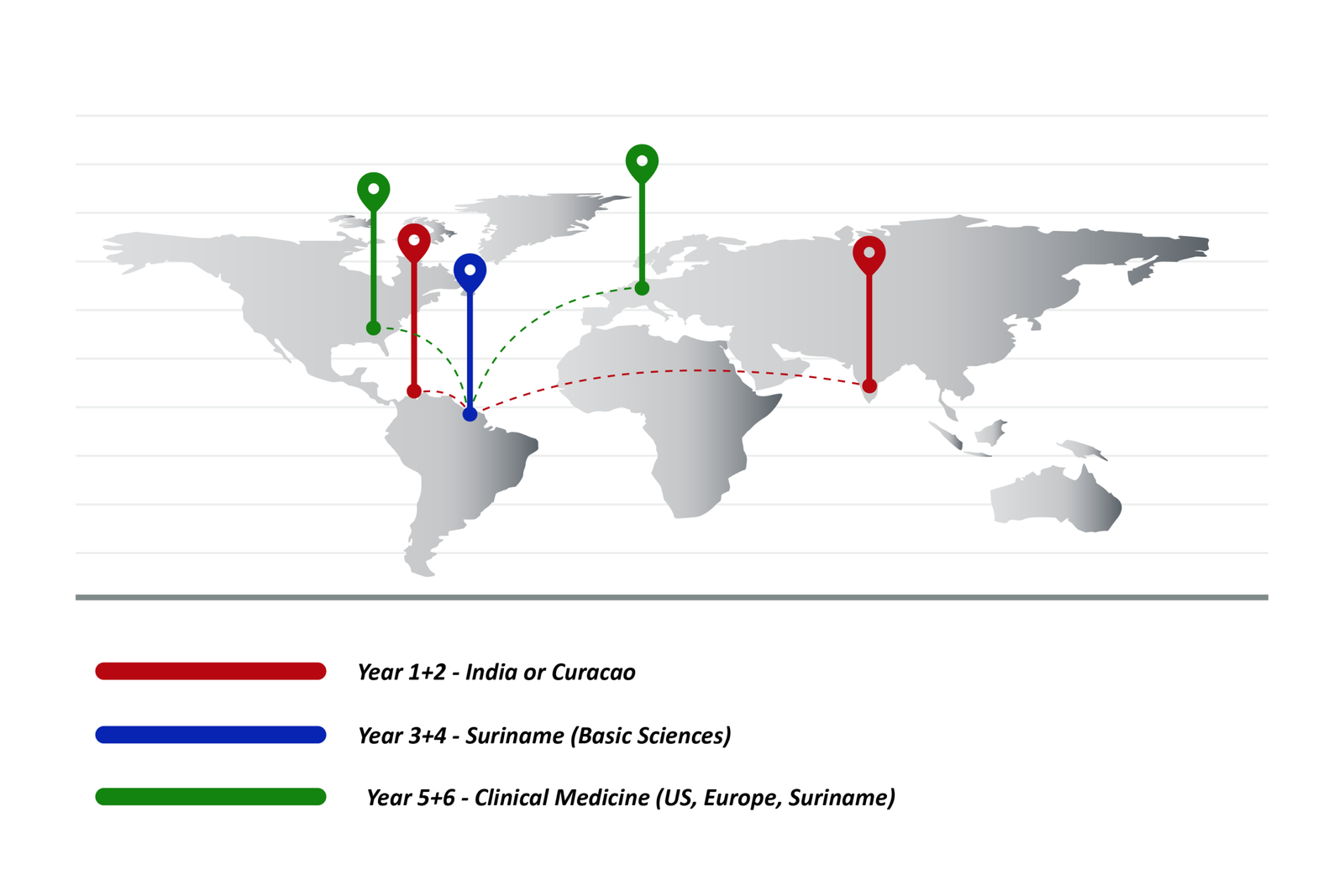
Hospital-Integrated from Year One
SAIU is located within the St. Vincentius Hospital in Paramaribo, Suriname. Unlike most Caribbean medical schools, SAISOM students train alongside practising post-graduate specialists from their very first year.
This model mirrors the traditional form of medical education used in North America and Europe, giving students a genuine clinical foundation before entering full rotations.
Government Charter – Suriname
WHO Notification
ECFMG / USMLE Eligible
Educational Requirements
SAISOM recognises that students come from diverse educational backgrounds. Each applicant is evaluated individually and placed into the programme most suited to their qualifications.
Bachelor’s Degree Applicants
Other Education Systems
Transfer Students
Applicants holding a Bachelor’s Degree from a US, Canadian or British system of education are eligible to apply directly to the MD programme, provided the following college-level prerequisite courses have been completed:
| Subject | Credit Hours | Notes |
|---|---|---|
| Inorganic / General Chemistry | 8–12 | Must include laboratory component |
| Organic Chemistry | 8–12 | Must include laboratory component |
| General Biology or Zoology | 8–12 | Must include laboratory component |
| Physics | 8–12 | Must include laboratory component |
| College-level Mathematics | 3–5 | Calculus or Statistics |
| English / Language Arts | 6–9 | |
| Supplementary Study | 3–5 | See note below |
Supplementary study suggestions: Physiology; Biochemistry; Foreign Languages; Computer Science & Statistics; Microbiology.
A minimum of 96 credit hours must be completed prior to enrolment. SAIU does not require the MCAT.
A minimum of 96 credit hours must be completed prior to enrolment. SAIU does not require the MCAT.
Applicants who have completed their undergraduate studies under a system other than the US, Canadian or British model will be assessed on individual merits. A pre-medical curriculum comparable to the prerequisites above will be expected.
Applicants with a high school degree, pre-university qualification, IB programme or A-levels (all with sciences) must first complete the pre-medical programme at the South American International College of Health Sciences (SAICHS):
(a) Bachelor of Science in Medical Studies
A full BSc qualification with a medical science focus. Upon successful completion with the required GPA, students are admitted directly to the MD programme.
(b) Accelerated Pre-Medical Science Programme
A condensed pathway for eligible students. Upon successful completion with the required GPA, students are admitted to the MD programme.
Transfer Students & Advanced Standing
Students enrolled or previously enrolled in a WHO-recognised medical school may apply for admission with advanced standing. Official transcripts must be sent directly from the previous institution to SAIU. Course descriptions, credit evaluations, and where required, certified translations must be provided. Credits are assessed by the SAIU Registrar on a course-by-course basis.
MBBS vs MD – Pathway Comparison
The chart below compares the MBBS pathway with the SAIU MD programme for both the US Route and the European Route, from entry qualification through to specialisation.
South American International University (SAIU)
School of Medicine – MBBS vs MD Pathways
Challenging High School Degree with ScienceHigher Secondary Certificate (10+2) | A-Levels | IB | VWO
MBBS Pathway
MD Pathway
US Route
US Route
MD Pathway
Europe Route
Europe Route
Years 1–5.5
MBBS5½ years (PMQ)
Year 5.5
NEET PG
Years 1–2
Accelerated BSc.(2 years)
+
Years 3–4
M.D. – Basic Sciences2 years (PMQ) • 4 years total
+
Years 5–6
USMLE 1Clinical Medicine • Clerkships/Rotations (2 yrs)USMLE (CK + CS)
Years 1–2
Accelerated BSc.(2 years)
+
Years 3–4
M.D. – Basic Sciences2 years (PMQ) • 4 years total
+
Years 5–6
SAIU PMQ ExamClinical Medicine • Clerkships/Rotations (2 yrs)Clinical Exam
Thesis Required
After Qualification
Year 9+
3+ Years Practical Experience
+
Year 12
SpecialisationNMB – Ph.D – Doctorate
Year 9+
3+ Years Practical ExperiencePGY1 – PGY2 – PGY3
+
Year 12
SpecialisationNMB – Ph.D – Doctorate
Year 9+
3+ Years Practical ExperienceHospital Residency
+
Year 12
SpecialisationSAIU Doctorate
Post-Graduate Specialisation Programmes
SAISOM offers advanced M.Ch. and MS post-graduate training in specialist disciplines. Each is a three-year, competency-based programme with structured clinical rotations, logbook requirements and formal board examinations. Click any programme below to view the full syllabus.
Vascular Surgery
M.Ch. – 3 YearsArterial, venous and endovascular disease including open reconstructions, aneurysm repair and minimally invasive interventions. Rotations in Radiology and Cardiology.
Aneurysmal DiseaseEndovascular TherapyCarotid SurgeryVascular TraumaView Syllabus ↓
Gynaecological Oncology
M.Ch. – 3 YearsSurgical, radiation and medical oncology for gynaecological cancers. Diagnostic staging, radical surgery, chemotherapy, radiotherapy and palliative care.
Staging & DiagnosticsRadical SurgeryRadiation TherapyPalliative CareView Syllabus ↓
Urology
M.Ch. – 3 YearsComprehensive training in open and endoscopic urological surgery covering the urogenital system, renal transplantation, uro-oncology, reconstructive urology and paediatric urology.
EndourologyUro-oncologyRenal TransplantPaediatric UrologyView Syllabus ↓
Orthopaedics
MS – 3 YearsTrauma, joint replacement, spinal surgery, paediatric orthopaedics and musculoskeletal oncology with skills laboratory and logbook-based progression.
Fracture ManagementArthroplastySpine SurgeryArthroscopyView Syllabus ↓
Further Specialisations Available
In addition to the four programmes with full published syllabuses above, SAISOM offers post-graduate training in the following specialisations. Places are limited and admission is competitive. Contact the admissions office for programme details and current availability.
Programme Syllabuses
The M.Ch. Vascular Surgery programme trains post-graduate students in the full spectrum of vascular disease: arterial, venous and lymphatic conditions throughout the body, excluding intracranial vessels and the heart. The programme follows a competency-based framework with structured rotations in Vascular Surgery, Radiology and Cardiology over three years.
Applied Basic Sciences
- Embryology of the vascular system
- Physiology and pathophysiology of blood vessels
- Haemodynamics and atherosclerosis
- Endothelial cells, platelets and smooth muscle
- Response of arterial wall to injury and intimal hyperplasia
- Venous system physiology and pathophysiology
- Diabetic vascular disease and plasma lipoproteins
- Coagulation and haemostasis disorders
- Vascular grafts and endovascular devices
- Statistics for the vascular surgeon
Clinical Competencies
- Aneurysmal disease: aortic arch, thoracoabdominal, abdominal and peripheral
- Peripheral vascular occlusive disease
- Carotid, renal and visceral artery disease
- Thoracic outlet syndrome and acute arterial occlusion
- Vascular trauma management
- Venous thromboembolic disease and chronic venous insufficiency
- Endovascular therapy for occlusive and aneurysmal disease
- Varicose veins, lymphoedema and vascular access
- Diabetic foot problems and amputation
- Arteriovenous malformations and fistulae
Minimum Procedures – 3 Years
AV Fistula30 procedures
Peripheral Artery Exposure30 procedures
Embolectomy3 procedures
Femoro-popliteal / Aorto-femoral Graft5 procedures
Abdominal Aortic Aneurysm3 procedures
Carotid Endarterectomy3 procedures
Vascular Graft Anastomosis5 procedures
Saphenous Vein Harvest20 procedures
Hybrid / Endovascular AAA Repair2 procedures
Year
Vascular Surgery
Rotations
Year 1
9 months – First assistant in open vascular reconstructions; inpatient and outpatient clinical work
3 months Radiology – duplex, CT, MRI, DSA, endovascular observation
Year 2
9 months – Operating room focus: suturing technique, aortic control, graft and vein anastomosis
3 months Radiology – endovascular techniques, post-procedural management
Year 3
10 months – Independent exposure to lower limb revascularisation, carotid, renal and aneurysm repair
1 month Radiology; 1 month CTVS & Cardiology (2 weeks each)
Summative Examination – 4 Theory Papers
Paper I
Basic Sciences Applied to Vascular Surgery
Paper II
Vascular Surgery
Paper III
Vascular and Endovascular Surgery
Paper IV
Recent Advances in Vascular Surgery
Minimum 50% required in both Theory and Practical/Clinical examinations separately. Clinical examination: one long case and three short cases including at least one post-operative case. Logbook to be certified and submitted at least 6 weeks before Part 2 examination. Minimum 50 vascular procedures to be completed over three years.
The M.Ch. Gynaecological Oncology programme trains specialists in the surgical, radiation and medical management of gynaecological cancers including cervix, uterus, ovary, vulva, vagina and fallopian tube. The course spans 36 months with structured clinical postings and mandatory logbook documentation.
Diagnostic Techniques & Staging
- FIGO and TNM staging for all gynaecological cancers
- Colposcopy of cervix, vagina and vulva
- Cystoscopy, hysteroscopy, proctosigmoidoscopy
- CT, MRI, PET-CT and ultrasonography
- Tumour markers: HCG, AFP, CEA, CA125
- Cervical and endometrial biopsies, LEEP, cone biopsy
- Transvaginal and transabdominal needle biopsy
Surgery for Gynaecological Cancers
- Radical, total abdominal and vaginal hysterectomy
- Pelvic and para-aortic lymphadenectomy
- Radical vulvectomy, inguinal and femoral dissection
- Debulking surgery for stage III/IV ovarian cancer
- Fertility-sparing surgery for early-stage disease
- Laparoscopic surgery for endometrial and cervical cancer
- Exenteration procedures
Radiation Therapy
- Radiobiology and cell cycle kinetics
- External beam therapy and linear accelerator principles
- 3D-CRT, IMRT and IGRT techniques
- Brachytherapy: intracavitary systems and dose specification
- Image-guided brachytherapy
- Radiotherapy to cervix, uterus, vagina, vulva and ovaries
- Management of early and late radiation complications
Chemotherapy & Targeted Therapy
- Taxanes, alkylating agents, antimetabolites, vinca alkaloids
- Targeted therapy and immunotherapy
- Pharmacokinetics, drug interactions and toxicity
- Intraperitoneal and high-dose chemotherapy
- Clinical trials: Phase I–IV, randomisation
- Gestational trophoblastic disease
- Palliative chemotherapy
Pathology of Gynaecological Cancers
- Premalignant and malignant lesions: vulva, vagina, cervix
- Uterine carcinoma, sarcoma and carcinosarcoma
- Ovarian tumours: serous, mucinous, germ cell, sex cord
- Fallopian tube carcinoma
- Immunohistochemistry and receptor studies
- FIGO staging, tumour grade, margins and LVI
Palliative Care
- Pain relief: WHO analgesic ladder and neural blocks
- Nausea, vomiting and anxiety management
- Community support and hospice care
- Breaking bad news to patients and relatives
- Communication skills and professional ethics
Minimum Procedures – 30 Months Clinical Posting
Pelvic & Para-aortic Node Dissection15 cases
Complete Ureteric Dissection12 cases
Radical Abdominal Hysterectomy12 cases
Radical Vulval Excision + Groin Dissection5 cases
Laparotomy – Stage III/IV Ovarian Cancer25 cases
Fertility-Sparing Surgery5 cases
Type I Hysterectomy – Ca Endometrium10 cases
HIPEC and Robotic SurgeryExposure required
Summative Examination – 4 Theory Papers
Paper I
Basic Sciences, Epidemiology & Preventive Oncology
Paper II
Surgical Aspects in Gynaecological Oncology
Paper III
Medical and Radiation Oncology
Paper IV
Recent Advances including Clinical Trials
Minimum 50% cumulative with at least 40% in each theory paper. Practical examination: one long case, three short cases and viva-voce. Subjects assessed in viva: Surgical Anatomy, Instruments, Radiology, Surgical Pathology, Chemotherapy Drugs. Logbook mandatory throughout training.
The M.Ch. Urology programme produces competent urological surgeons trained across the full spectrum of diseases of the urogenital system and retroperitoneum. The three-year residency equips candidates to perform both open and endoscopic urological procedures independently, manage urological emergencies and carry out clinical research. Training is delivered through full-time residency with progressive clinical responsibility under faculty supervision.
Basic Sciences
- Applied anatomy and embryology of the urogenital system
- Physiology and pathophysiology of the kidney, bladder and urethra
- Biochemistry and pharmacology relevant to urology
- Pathology and microbiology of urological disease
- Immunology, epidemiology and research methodology
- Biostatistics and evidence-based surgical practice
- Computer science and scientific presentation
Investigative Urology & Imaging
- Genito-urinary radiology and nuclear medicine
- Retrograde urethrogram and micturating cystourethrogram
- Cystogram, nephrostogram, Whitaker test and sonogram
- Antegrade pyelography and vasoseminography
- Interpretation of DSA and venography
- Urodynamics: cystometrogram, urethral pressure profile, video urodynamics
- Assessment of sexual dysfunction: cavernosography, NPT studies
Clinical Sciences
- Male infertility, andrology and endourology
- Sexual dysfunction: investigations and management
- Urolithiasis: medical, biochemical and surgical aspects
- Uro-oncology: adult and paediatric
- Obstructive uropathy and urinary tract infections
- Sexually transmitted diseases
- Genito-urinary trauma
- Renovascular hypertension
- Gynaecological urology
- Neonatal urological problems
- Retroperitoneal diseases and management
- Medical aspects of kidney disease
Operative Urology
- Reconstructive urology and urethroplasty
- Paediatric urology: congenital malformations and acquired disease
- Renal transplantation: immunology, medical and surgical aspects
- Laparoscopic urological surgery
- Endourology: TURP, PCNL, ureterorenoscopy, laser surgery
- Electrocautery, lasers, fibre optics, catheters and endoscopes
- Perioperative care and management of urological complications
- Newer developments including robotic urology
Minimum Procedures – 3 Years
Endoscopies100 procedures
Internal Urethrotomy20 procedures
Transurethral Resection of Prostate25 procedures
Ureterorenoscopy25 procedures
PCNL & Endopyelotomy15 procedures
Pyeloplasty5 procedures
Urethroplasty5 procedures
Hypospadias Repair5 procedures
VVF Repair5 procedures
Internal Tract Reconstructions10 procedures
Donor Nephrectomy5 procedures
Recipient Surgery (Renal Transplant)2 procedures
Period
Clinical Focus
Procedures Covered
Year 1
(0–9 months)
(0–9 months)
Minor urological procedures, uro-radiological imaging and urodynamic studies; assessment of sexual dysfunction under supervision
Cystourethroscopy, retrograde pyelography, needle biopsy of prostate, trocar cystostomy, orchidectomy, circumcision, meatotomy; urodynamic studies including video urodynamics
Year 2
(9–23 months)
(9–23 months)
Endoscopic surgery and supervised open procedures with progressive independence; OPD consultations under consultant review
Internal urethrotomy, TURBT, stent insertion and retrieval, litholapaxy, bladder neck incision; simple and radical nephrectomy, pyeloplasty, urethroplasty, retropubic prostatectomy, VVF repair, surgery for undescended testis
Year 3
(24–36 months)
(24–36 months)
Complex open surgery and advanced endoscopic procedures with increasing autonomy; senior resident consultations to other departments
Augmentation cystoplasty, urinary diversion, nephroureterectomy, renal transplant, retroperitoneal lymphadenectomy, penile prosthesis; TURP, PCNL, ureterorenoscopy, laser surgery, laparoscopic urological procedures
Summative Examination – 4 Theory Papers
Paper I
Basic Sciences Applied to Urology
Paper II
Clinical Urology
Paper III
Operative Urology: Open and Endoscopic
Paper IV
Recent Advances in Urology
Minimum 50% required in both Theory and Practical/Clinical examinations separately. Attendance of at least 80% in each calendar year is mandatory. Logbook of operative procedures including any complications must be submitted before the practical examination for review by external examiners. Each candidate must carry out a thesis with results accepted for publication in an indexed national or international journal.
The MS Orthopaedics programme trains specialists to identify and manage congenital, developmental, inflammatory, infective, traumatic, metabolic, neuromuscular, degenerative and oncological disorders of the musculoskeletal system. Clinical skills develop progressively with skills laboratory sessions, logbook documentation and inter-unit rotations.
Basic Sciences
- Anatomy and function of joints, bone, cartilage, muscle and tendon
- Bone structure, growth factors and fracture healing
- Orthopaedic metallurgy, biomaterials and bone substitutes
- Stem cells and gene therapy in orthopaedics
- Diagnostic imaging: MRI, CT, DSA, musculoskeletal USG, PET, bone scan
Bone and Joint Disease
- Metabolic bone diseases: rickets, osteoporosis, Paget’s disease, fluorosis
- Bone and joint infections: osteomyelitis, septic arthritis, Pott’s spine
- Osteoarthrosis, gout, CPPD, collagen diseases, rheumatoid arthritis
- Poliomyelitis and post-polio residual palsy
- Cerebral palsy, myopathies, peripheral nerve injuries
- Bone tumours: benign, malignant and metastatic
Fractures and Trauma
- Classification, pathology and principles of fracture treatment
- Internal fixation: locking plates, LISS, intramedullary nailing, Ilizarov
- Fractures of upper and lower extremity, hip, pelvis and spine
- Open fractures, compartment syndrome and soft tissue coverage
- Malunion, delayed union and non-union
- Dislocations, sports injuries and joint trauma
- Triage, disaster management, ATLS and BTLS
Regional & Specialty Conditions
- Spine, shoulder, elbow, hand, wrist, hip, knee, foot and ankle
- Arthroplasty: knee, hip, ankle, shoulder and elbow
- Arthroscopy of knee, ankle, shoulder and elbow
- Spinal degenerative disorders: PIVD, canal stenosis, spondylolisthesis
- Paediatric orthopaedics: Perthes, CDH, CTEV, SCFE
- Amputations, prosthetics and orthotics; rehabilitation
Year
Clinical Skills Gained
Key Procedures
Year 1
History taking, examination, documentation; wound care; POP casts, splints and tractions; aspiration; skin grafting; external fixators
Closed reduction of dislocations; bone model work: compression screws, tension band wiring, plating; surgical approaches on cadaver
Year 2
Informed consent; biopsies; sequestrectomy; arthrotomy of major joints; hand tendon repair; small joint arthrodesis; corrective surgeries for CTEV, DDH
Internal fixation with K-wires, screws, DHS/DCS, nailing; Ilizarov fixator; carpal/tarsal tunnel release; amputations
Year 3
Polytrauma management; spinal decompressions and stabilisation; revision surgeries; limb lengthening; osteotomies
Assist arthroplasty (hip, knee, shoulder, ankle); operative arthroscopy; ORIF of complex fractures; assist bone tumour surgery
Summative Examination – 4 Theory Papers
Paper I
Basic Sciences as Applied to Orthopaedics
Paper II
Traumatology and Rehabilitation
Paper III
Orthopaedic Diseases
Paper IV
Recent Advances + General Surgery Applied to Orthopaedics
Minimum 50% in both Theory and Practical separately. Thesis submission required at least 6 months before the examination. Practical: one long case and three short cases. Viva subjects: Surgical Anatomy including Osteology, Instruments, Radiology, Surgical Pathology, Orthotics and Prosthetics.